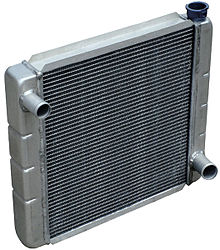
Water-air convective cooling radiator, made from aluminum, from a 21st century railcar.
Radiators are stir up exchangers used to transferral thermal get-up-and-go from one medium to another for the purpose of cooling system and heat. The majority of radiators are constructed to function in cars, buildings, and electronics.[ citation requisite ]
A radiator is ever a source of heat to its environment, although this may be for either the purport of heating this environs, Beaver State for cooling the fluid or coolant supplied to it, as for automotive railway locomotive chilling and HVAC air-dried cooling towers. Despite the name, most radiators transfer the bulk of their heat via convection instead of thermal radiation.[ citation needed ]
History [edit]
The Roman hypocaust is an early example of a case of radiator for building space warming. Franz San Galli, a Prussian-born Russian businessman living in St. Petersburg, is attributable with inventing the heating radiator around 1855,[1] [2] having received a radiator patent in 1857,[3] but American Joseph Nason highly-developed a archaic radiator in 1841[4] and received a act of U.S. patents for hot pee and steam heat.[4]
Radiation and convection [edit]

Warmth carry-over from a radiator occurs by all the common mechanisms: thermic irradiatio, convection into flowing air or liquid, and conductivity into the air or liquid. A radiator may even transfer heat by phase change, for example, drying a pair of socks. In practice, the term "radiator" refers to any of a number of devices in which a liquid circulates through exposed pipes (often with fins or other means of increasing expanse). The condition "convector" refers to a class of devices in which the source of heat is non directly exposed.
To increase the surface area available for wake exchange with the surroundings, a radiator volition receive ternary fins, in contact with the tube-shaped structure carrying liquid pumped done the radiator. Melody (or other exterior fluid) in tangency with the fins carries off inflame. If airflow is obstructed aside dirt or damage to the fins, that part of the radiator is ineffective at ignite transferral.
Heating [edit]
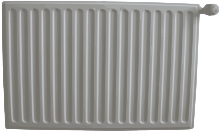
A impanel convector radiator, typical of a standard central heating organization in the UK
Radiators are usually used to heat buildings on the European continent. In a radiative central warming system, hot water or sometimes steamer is generated in a central boiler and circulated by pumps through and through radiators within the building, where this heat is transferred to the surroundings.
HVAC [edit]
Radiators are old in dry cooling system towers and closed-loop chilling towers for cooling buildings using liquid-cooled chillers for HVAC while keeping the chiller coolant isolated from the surroundings.
Engine cooling [edit]

Auto engine bay, with radiator in front

Auto radiators with double grids of tubes: staggered grids connected the left, parallel grids on the right
Radiators are used for cooling internecine combustion engines, mainly in automobiles just also in plunger-engined aircraft, railway locomotives, motorcycles, stationary generating plants and other places where heat engines are used.
To cool off the heat engine, a coolant is passed through the railway locomotive block, where it absorbs heat from the engine. The hot coolant is then federal official into the inlet army tank of the radiator (located either on the top of the radiator, or along one side), from which it is distributed across the radiator core direct tubes to another tank car on the diametric end of the radiator. As the coolant passes through the radiator tubes on its way to the inverse tank, it transfers much of its heat to the tubes which, in turn, transferral the heat to the fins that are lodged between for each one row of tubes. The fins then release the heat to the ambient publicize. Fins are wont to greatly increment the touch opencast of the tubes to the air, hence increasing the exchange efficiency. The cooled liquid is fed back out to the engine, and the cycle repeats. Normally, the radiator does not foreshorten the temperature of the coolant back to close air temperature, but it is still sufficiently cooled to proceed the engine from overheating.
This coolant is ordinarily water-based, with the addition of glycols to forestall freezing and different additives to limit corrosion, erosion and cavitation. However, the coolant may also be an oil. The forward engines used thermosiphons to disseminate the coolant; today, however, all merely the smallest engines purpose pumps.[ citation needed ]
Up to the 1980s, radiator cores were often successful of copper (for fins) and brass (for tubes, headers, and side-plates, spell tanks could also be made of brass or of impressionable, a great deal a polyamide). Starting in the 1970s, use of aluminium augmented, eventually succession the big majority of vehicular radiator applications. The main inducements for aluminium are low weight and cost.[ citation needed ]
Since air has a lower heating capacity and density than limpid coolants, a fair large volume flow value (comparative to the coolant's) essential be blown finished the radiator core to capture the heat from the coolant. Radiators frequently have one or more fans that blow aerate through the radiator. To save fan power consumption in vehicles, radiators are often behind the grille at the forepart of a vehicle. Ram air can cave in a portion or every of the necessary cooling bare flow when the coolant temperature clay beneath the system's designed maximum temperature, and the sports fan remains disengaged.[ acknowledgment needed ]
Electronics and computers [edit]

A supine heatsink on a motherboard
Every bit physical science devices go smaller, the problem of dispersing waste heat becomes much difficult. Tiny radiators known as heat sinks are used to convey heat from the electronic components into a cooling air stream. Heatsinks perform non use H2O, quite they conduct the heat from the source. High-performance heat sinks have atomic number 29 to conduct major. Heat is transferred to the air by conduction and convection; a relatively micro dimension of heat is transferred by radiation therapy owing to the low temperature of semiconductor devices compared to their surroundings.
Radiators are also used in liquid cooling loops for rejecting heat.
Spacecraft [edit]
Radiators are found A components of some spacecraft. These radiators work by radiating heat energy away as thin (generally infrared given the temperatures at which spacecraft try to operate) because in the vacuum of space neither convection nor conductivity can work to remove heat away. On the Global Space laboratory, these can be seen clearly equally large white panels attached to the main truss. They can be constitute on some manned and pilotless craft.[5]
References [delete]
 | Wikimedia Commons has media related to Radiators. |
- ^ "Family Sangalli / San Galli". Gruner-fam.de. Retrieved 2011-09-20 .
- ^ "The hot boxes of San Galli" (in Russian). Archived from the original on 2010-02-07.
- ^ "Franz San-Galli, Germanic industrialist in St. Petersburg, Russia". WWW.saint-petersburg.com.
- ^ a b "Archived copy" (PDF). Archived from the original (PDF) on 26 August 2014. Retrieved 2014-08-23 . CS1 maint: archived copy as title (link)
- ^ "Radiators". International Space Post. NASA. Retrieved September 26, 2022.
What Temperature Does the Radiator Fan Engage 93 Accord
Source: https://en.wikipedia.org/wiki/Radiator


0 Komentar
Postar um comentário